
Do V-Loop Hair Systems Shed? (Quick Answer)
Yes. V-loop hair systems can shed, and they are generally more susceptible to hair loss than properly constructed knotted hair systems.
The reason is their hair attachment method. V-loop hair is just through a thin polyurethane (PU) skin base without conventional knots. This creates a natural-looking with minimal visible knots, but the hair may be more vulnerable to loosening from repeated pulling, friction, and rough handling.
The amount of shedding depends on several factors, including knots, skin oil, base construction, hair density, manufacturing standards, maintenance habits and so on.
In short: V-loop hair systems prioritize a natural-looking, knotless appearance, while traditional knotted systems generally provide better hair retention. Proper care can help reduce unnecessary shedding, although no hair system can guarantee zero hair loss.
1. What Is a V-Loop Hair System?

(BUY NOW: HairNotion offers all V-loop skin hair systems in thicknesses ranging from 0.02mm to 0.12mm—whatever thickness you need, you can find it here. Our all V-loop skin toupees are now on major sale for just $149.99 USD, with free shipping included.)
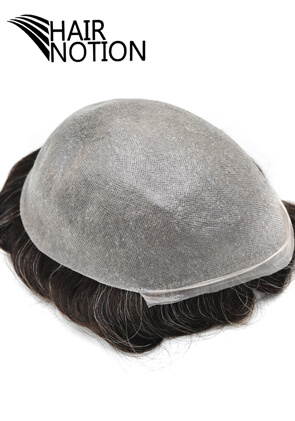
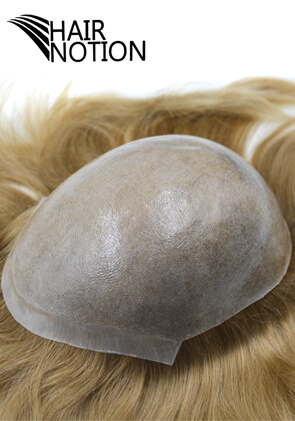
A V-loop hair system is a type of men’s hair replacement system in which individual human hair strands are ventilated through a thin polyurethane (PU) skin base in a V-shaped pattern.
Unlike traditional knotted hair systems, V-loop construction does not use conventional knots to secure the hair.
This creates several visual advantages:
No conventional visible knots at the V-loop attachment points.
A natural-looking hairline.
A smooth, scalp-like base appearance.
Flexible styling possibilities, depending on the hair direction and density.
V-loop systems are particularly popular among men who want a discreet hair replacement solution with a realistic front hairline.
However, there is a trade-off. Because the hair is not secured with traditional knots, V-loop construction can be more vulnerable to shedding under repeated tension.
How Does V-Loop Ventilation Work?
During production, individual hair strands are looped through the polyurethane base and arranged to create a V-shaped attachment.
The result is an attachment structure designed to minimize the appearance of knots.
This is different from traditional knotting, where hair is tied to the base using small knots. It is also different from injected hair construction, where hair is inserted into a skin base using a different attachment process.
Understanding these differences is important because the attachment method influences the appearance, handling requirements, and potential durability of a hair system.
2. Why Do V-Loop Hair Systems Shed?
There are five common factors that can contribute to V-loop hair system shedding.
2.1 The V-Loop Hair Attachment Method
The main reason is the way the hair is attached to the base.
V-loop ventilation is designed to achieve a natural-looking, knotless appearance. However, without conventional knots, individual strands may become loose more easily when exposed to repeated tension.
For example, aggressive brushing, pulling tangled hair, and repeatedly tugging at the hairline can place unnecessary stress on the attachment points.
This does not mean that every V-loop hair system will shed excessively. Manufacturing quality and handling habits make a significant difference.
The main trade-off: V-loop construction offers a more discreet attachment appearance, while traditional knots generally provide stronger mechanical hair retention.
2.2 An Ultra-Thin Polyurethane Base
Many V-loop hair systems use ultra-thin skin bases to create a natural-looking finish.
A thinner polyurethane base can sit close to the scalp and make the base edge less noticeable. However, it also requires careful handling.
Repeated stretching, pulling, and rough cleaning can damage the base or put additional stress on the hair attachment points.
It is important to understand that base thickness and hair attachment are two different factors.
A thicker skin base does not automatically prevent shedding, and a thin skin base does not automatically mean poor quality.
The actual performance depends on the complete construction.
2.3 Aggressive Brushing and Combing
Rough brushing is one of the most avoidable causes of unnecessary hair loss.
Common mistakes include:
Pulling a comb through tangled hair.
Brushing forcefully from the roots.
Tugging at the front hairline while styling.
Brushing aggressively when the hair is wet.
Repeatedly pulling the hair into tight hairstyles.
Because V-loop hair is not secured with conventional knots, repeated tension can loosen strands from the base.
How to avoid it: Use a wide-tooth comb or a suitable hair-system brush. Start detangling at the ends and gradually work toward the roots.
Avoid pulling directly on the base.
2.4 Incorrect Washing and Styling
Washing is necessary to keep a hair system clean, but excessive friction can contribute to shedding and hair damage.
Potential problems include:
Scrubbing the hair or base vigorously.
Using very hot water.
Pulling or twisting the hair while drying.
Applying excessive heat near the PU base.
Using unsuitable styling or chemical products.
Water alone does not automatically cause V-loop shedding.
The bigger concern is the combination of moisture, friction, mechanical tension, and improper handling.
Use gentle washing techniques and follow the care instructions for your specific hair system.
2.5 Manufacturing and Ventilation Quality
Not all shedding is caused by the wearer.
The quality of the ventilation process, consistency of hair attachment, hair processing, and overall manufacturing standards can influence the performance of a V-loop hair system.
A poorly constructed system may develop shedding problems earlier than expected.
When evaluating a supplier, consider more than the appearance of the finished product.
Ask about:
The actual hair attachment method.
Ventilation consistency.
PU base thickness.
Hair density and processing.
Quality inspection procedures.
Expected wear time and maintenance requirements.
A natural-looking hairline is important, but construction quality matters just as much.
3. Is It Normal for a New V-Loop Toupee to Shed?
A few loose hairs during initial handling or washing do not necessarily mean that a V-loop toupee is defective.
What matters is the amount of hair loss and whether it continues or becomes more noticeable over time.
Here is a practical guide:
| What You Notice | What It May Mean |
|---|---|
| A few loose hairs during initial handling | May be residual loose hairs from production or handling |
| Occasional loose strands during gentle styling | May occur with V-loop construction |
| Gradually reduced hair density | May indicate ongoing shedding, friction, or wear |
| Noticeable bald spots after minimal use | May indicate a construction, quality, or handling problem |
| Sudden heavy shedding during gentle washing | Warrants closer inspection |
These are general indicators rather than fixed manufacturing standards.
If your new hair system develops obvious bald spots or loses substantial amounts of hair after gentle use, take photographs and contact your supplier for an assessment.
Shedding vs. Hair Breakage: What Is the Difference?
Shedding and breakage are two different problems, although both can make a hair system look thinner.
Shedding occurs when a hair strand comes out of the base.
Breakage occurs when the hair shaft snaps, leaving shorter strands behind.
How can you tell the difference?
Full-length strands coming out may indicate shedding.
Shorter broken strands may indicate hair damage.
Increasingly thin areas may indicate progressive shedding or a combination of both.
If the hair becomes dry, brittle, or shorter over time, examine your brushing habits, heat exposure, chemical treatments, and hair-care products.
If complete strands are coming out, investigate the hair attachment method and how the system is being handled.
4. How to Prevent V-Loop Hair System Shedding
You cannot completely eliminate shedding, but proper maintenance can reduce unnecessary stress on the hair and base.
Tip 1: Comb Gently and Avoid Pulling
Always detangle from the ends toward the roots.
Hold the hair near the area being detangled to reduce pulling force on the base.
Work through tangles gradually instead of forcing a comb through them.
Avoid excessive brushing, especially around the front hairline, where maintaining density is particularly important.
Tip 2: Wash Without Excessive Friction
Use lukewarm or cool water and a gentle washing technique.
Do not scrub the base aggressively or rub the hair into a tangled mass.
Rinse carefully and avoid twisting or wringing the unit to remove water.
There is no single washing frequency suitable for every wearer. Adjust your routine according to scalp oil, sweat, styling-product buildup, adhesive instructions, and the manufacturer’s recommendations.
Tip 3: Apply Conditioner Carefully
Conditioner can help keep human hair soft and manageable.
However, heavy conditioning products around the hair attachment points may interfere with some adhesive systems or make maintenance more difficult.
Apply conditioner mainly to the mid-lengths and ends of the hair.
Avoid saturating the roots and base unless the product instructions specifically allow it.
Tip 4: Limit Heat and Chemical Treatments
Excessive heat can damage human hair fibers and may deform or weaken a polyurethane base.
When styling:
Use low heat when appropriate.
Keep heat away from the base.
Avoid excessive blow-drying.
Do not use aggressive chemical treatments without checking compatibility.
Use suitable products designed for processed human hair.
If you plan to dye or chemically process your hair system, ask the supplier first.
Tip 5: Remove Adhesive Carefully
Adhesive removal is another stage when hair systems can be damaged.
Use a remover compatible with your adhesive and base.
Allow the remover to work as directed before releasing the system. Never pull the hairpiece off forcefully or use the hair as a handle.
When cleaning the base, avoid excessive scraping, stretching, or tugging at the attachment points.
Tip 6: Store the Hair System Properly
When the system is not being worn, keep it in a clean, dry place away from excessive heat and direct sunlight.
Use a suitable stand or storage method to prevent tangling and unnecessary pressure on the hairline.
Good storage will not restore lost hair, but it can help reduce avoidable damage between wears.
5. Do Thicker V-Loop Skin Bases Shed Less?
Not necessarily.
Base thickness can influence how substantial and easy to handle a hair system feels, but it does not independently determine how securely the hair is attached.
HairNotion offers thin skin hair systems in different thicknesses, including 0.04–0.06 mm and 0.06–0.08 mm options, as well as other constructions depending on the model.
Here is how to understand the general trade-offs: The thinner the skin, the more natural it looks; the thicker the skin, the less likely it is to tear.
| Consideration | Ultra-Thin Skin | Thicker Skin |
|---|---|---|
| Natural-looking base edge | Can be exceptionally discreet | May be more noticeable depending on design |
| Base handling | Requires careful handling | Generally more substantial |
| Hair shedding | Depends on quality and care | Thickness alone does not guarantee less shedding. However, the thicker the material, the less likely it is to tear. |
| Main consideration | Natural appearance | Base robustness and handling preferences |
Important: A thicker skin base does not automatically make a V-loop hair system more resistant to shedding. but the thicker the skin, the less likely it is to tear.
Hair attachment quality, ventilation technique, hair length, density, and maintenance remain important.
If minimizing shedding is your highest priority, compare the actual attachment method rather than choosing a product based on thickness alone.

6. V-Loop vs. Knotted Hair Systems: Which Sheds Less?
The main difference is how the hair is secured to the base.
| Feature | V-Loop Hair System | Knotted Hair System |
|---|---|---|
| Hair attachment | Hair is looped through the base without conventional knots | Hair is secured with knots |
| Visible knots | Minimal or absent at V-loop attachment points | Knots may be visible depending on the base and knot type |
| Natural-looking hairline | Excellent potential for an invisible-looking finish | Can also have invisible hairline , depending on construction |
| Shedding resistance | Generally more vulnerable to shedding | Generally better hair retention when properly constructed |
| Maintenance | Requires gentle handling | Still requires proper care |
| Main advantage | Natural-looking, knotless appearance | More secure hair attachment in many constructions |
Neither option is universally better.
Choose V-loop if a natural-looking, knotless hairline is your main priority and you are comfortable handling a delicate hair system.
Consider a knotted or hybrid construction if you want a different balance of durability and realism.
For example, some hybrid systems use V-loop ventilation in the front hairline and more securely knotted hair in other areas.
This allows wearers to benefit from a natural-looking front while using a different attachment method elsewhere.
-Buy your need v-loop or front v-loop skin hairpiece now
7. V-Loop vs. Injected Hair Systems: What Is the Difference?
V-loop and injected hair systems are both designed to create a natural-looking appearance without traditional visible knots at the attachment points.
However, their construction methods differ.
V-loop hair systems use hair strands looped through a polyurethane base in a V-shaped pattern.
Injected hair systems use a different technique in which hair is inserted into the skin base to create a natural-looking growth direction.
Neither method should automatically be considered superior in every situation.
Their performance depends on the specific base, hair attachment quality, manufacturing process, and maintenance.
When comparing the two, consider:
How natural the hairline looks.
How the hair is attached to the PU base.
Whether the hair can be styled in your preferred direction.
Expected durability.
Hair retention under normal use.
Ease of maintenance.
If you are considering a thin skin hair system, ask the manufacturer about the exact construction rather than assuming all V-loop or injected systems perform the same way.
The V-loop technique creates a more natural hair growth direction and offers better control.
While the injected skin method provides a more secure attachment, it does not allow for a fully swept-back hairstyle.
V-loop VS Knots VS Injected Production Video:
8. Which Men’s Hair System Should You Choose?
The best men’s hair system depends on what matters most to you.
Here is a practical comparison based on appearance, hair retention, and maintenance requirements.
| Your Priority | Construction to Consider | Why |
|---|---|---|
| Natural-looking knotless hairline | V-loop | No conventional visible knots at the attachment points |
| Better hair retention | Properly constructed knotted system | Knots provide additional mechanical security |
| Natural appearance with a different durability balance | Hybrid V-loop and knotted construction | Combines different attachment methods in different areas |
| Smooth, discreet skin base | Thin skin hair system | Provides a close-fitting polyurethane base |
| A balance between natural appearance and durability | Injected skin or front v-loop skin toupee | Performance depends on the complete design |
Is V-Loop Suitable for First-Time Hair System Wearers?
Yes. V-loop can be suitable for first-time wearers who prioritize a natural-looking hairline.
However, beginners should understand that V-loop hair requires gentle brushing, washing, and removal.
If durability is their primary concern, they should also compare knotted constructions before purchasing.
What Should You Ask a Supplier Before Buying a V-Loop Toupee?
Before purchasing, ask these questions:
Is the hair fully V-looped or is it a hybrid construction?
What is the polyurethane base thickness?
What hair retention and expected lifespan can I reasonably expect?
What maintenance routine does the manufacturer recommend?
What support is available if excessive shedding occurs?
Getting these details before ordering helps you compare products more accurately.
9. How Long Does a V-Loop Hair System Last?
There is no universal lifespan for every V-loop hair system. Fatory said: depending on the skin thickness, a 0.02–0.03 mm piece lasts about 2 weeks, while a 0.04–0.06 mm piece lasts around 1 month; generally, the thicker the skin, the longer its usable lifespan.
Actual wear time depends on:
Base thickness and material.
Hair attachment and manufacturing quality.
Hair length and density.
How frequently the system is worn and washed.
Brushing, sleeping, exercise, and daily friction.
Adhesive removal and maintenance habits.
The wearer’s expectations for acceptable density and appearance.
Some ultra-thin V-loop systems are designed for relatively short-term use, while other constructions may last longer under suitable conditions.
Published lifespan estimates should be treated as guidelines, not guarantees.
One important consideration is that a hair system may remain physically wearable after it no longer looks as full or natural as you want.
For many wearers, progressive shedding and changes in appearance are practical reasons to replace a unit.
Before buying, ask the supplier about the expected wear time for the exact model, its ventilation method, and the conditions under which the estimate applies.
10. How HairNotion Evaluates Thin Skin Hair System Quality
At HairNotion, we believe choosing a men’s hair replacement system involves more than looking at skin thickness or hair appearance.
The hair attachment method, base construction, and expected durability should all be considered together.
When evaluating a thin skin hair system, we recommend paying attention to four factors.
1. Hair Attachment Consistency
The ventilation should be consistent across the base.
Uneven attachment or poorly controlled production may affect hair retention and the overall appearance.
2. Base Thickness and Flexibility
Thinner polyurethane bases can provide a more discreet appearance, but they require careful handling.
Buyers should consider the balance between natural appearance and everyday durability.
3. Hair Density and Styling Requirements
Hair density, length, and styling habits can affect how much tension is placed on the attachment points.
Longer or frequently styled hair may require extra care.
4. Manufacturing Quality Control
A hair system should be evaluated not only by its appearance when new, but also by the consistency of its construction and its performance during normal use.
At HairNotion, we recommend choosing a hair system according to your priorities: a natural-looking hairline, everyday durability, or a balance of both.
If you are unsure which construction is suitable, ask about the specific ventilation method and base specifications before ordering. (Contact HairNotion: [email protected])
11. Explore HairNotion Thin Skin Men’s Hair Systems
If you are looking for a natural-looking men’s hair replacement system, compare the base thickness and hair attachment method before choosing.
HairNotion offers different thin skin hair system constructions to help wearers find a balance between natural appearance and everyday practicality.
Our 0.04–0.06 mm full skin human hair toupee is one option for men who prefer a relatively thin polyurethane base.
Explore the product:
HairNotion 0.04–0.06 mm Full Skin Human Hair Toupee for Men
Before ordering, compare the available specifications and ask HairNotion about the knots method, hair density, and maintenance requirements of the model you are considering.
Choosing the right construction is more important than simply choosing the thinnest base.
Frequently Asked Questions About V-Loop Hair System Shedding
1. Do V-loop hair systems shed more than knotted systems?
Generally, yes. V-loop hair is not secured with conventional knots, so strands can become loose more easily under repeated tension. Actual shedding still depends on construction quality and maintenance.
2. Is shedding normal for a V-loop toupee?
A small number of loose hairs may appear during initial handling or normal use. Persistent heavy shedding, rapidly decreasing density, or bald spots should not automatically be considered normal.
3. Why is my new V-loop hair system losing hair?
Possible causes include residual loose hairs from production, rough handling, excessive friction, unsuitable washing practices, or manufacturing and attachment problems. The timing and severity of shedding help determine what to investigate.
4. Can I stop a V-loop toupee from shedding?
You cannot guarantee zero shedding, but you can reduce unnecessary hair loss by combing gently, avoiding vigorous washing, limiting heat, keeping conditioner away from attachment points, and removing adhesive carefully.
5. Does a thicker skin base prevent shedding?
Not necessarily. A thicker base may be more substantial, but shedding also depends on ventilation technique, attachment quality, hair density, and care. Thickness alone cannot guarantee better hair retention.
6. Does a V-loop hair system last as long as a knotted system?
Not necessarily. V-loop systems are generally more susceptible to shedding, while properly constructed knotted systems can offer better hair retention. The actual lifespan of either type depends on its design and how it is maintained.
7. Should I return a hair system if it sheds after the first wash?
Not based on a few loose strands alone. If substantial hair loss occurs after gentle washing, document the problem and contact the supplier. Check the product’s warranty and return terms before deciding what to do.
8. Is V-loop or injected hair better for preventing shedding?
Injected hair is btter, However, injected skin cannot be styled with the hair swept entirely back. Neither method should be judged by its name alone. Both are knotless attachment approaches, and retention depends on the specific construction, manufacturing quality, and maintenance. Ask the supplier for details about the exact model rather than assuming one method will always shed less.
9. Is V-loop a good choice for everyday wear?
It can be, provided the wearer understands its maintenance requirements. Daily brushing, washing, sleeping habits, and removal techniques can all influence how well the hair system maintains its appearance.
10. What is the best way to reduce V-loop hair shedding?
The most practical approach is to minimize tension on the hair attachment points. Detangle from the ends, wash gently, avoid aggressive styling, use compatible adhesive removers, and follow the manufacturer’s care instructions.
Final Thoughts: Is a V-Loop Hair System Worth Buying?
Yes, a V-loop hair system can be a good choice if a natural-looking, knotless hairline is your priority.
However, it is important to understand its limitations.
V-loop construction can be more vulnerable to shedding than traditional knotted hair attachment methods. This does not make every V-loop system low quality, but it does mean that manufacturing consistency and proper maintenance matter.
Before choosing a men’s hair replacement system, consider three things:
Appearance: How natural do you want the hairline to look?
Durability: How important is long-term hair retention?
Maintenance: Are you comfortable handling and caring for a delicate hair system?
The best choice is the one that balances your appearance preferences, expected durability, and daily routine.
Looking for a suitable thin skin hair system? Explore HairNotion’s men’s hair replacement options and compare the available base constructions before ordering.